Quiz first · then the comparison · updated November 2026

Six real cases, solved in seven days.

Which came first? · tap the older event

1 of 5

2 of 5

3 of 5

4 of 5

5 of 5

Dates that historians still debate are left out, so each pair has one answer.

That round is the same shape as PastRush's Which Came First? game, with our dates and sources. The best history games for kids, compared, are below; the seven-day challenge after that.

Five history games for kids, from their listings

AppPrice and purchasesAds, accountsWhat a child doesAge · size · iOS
PastRush: History DetectiveHonest Little Apps · oursFree: 6 of 12 investigations, globe, Notebook, daily check; Founder Lifetime one-time purchase for cases 7–12No ads, no account, no tracking; Class mode hides purchasesOrder events, compare sources, trace causes, sort claims; every answer explains why and links a source; exhibits labelled by type9+ · 90 MB · iOS 18
Paladin: Learn HistoryBrainstashFree download; purchases listing does not saylisting does not sayShort animated lessons on figures like Cleopatra and Lincoln, each followed by a quiz; level up to open more12+ · 173 MB · iOS 16.4
History for Kids: All CivilizationsPlanet FactoryFree content plus paid content, per listinglisting does not sayMultiple mini-games, HD images and videos across civilizations; ages 7 and up per listing4+ · 297 MB · last updated 2017
Deep Blue Archaeology for KidsBytwiceFree download; MagisterApp Plus subscription with 7-day trial for all its gamesNo ads with the subscription, per listingUnderwater archaeology adventure; real shipwrecks with audio stories in 10 languages; for preschool and young children4+ · 163 MB · iOS 12
Eventology - History TriviaSpinning PlatesFree download; purchases listing does not saylisting does not sayTrivia on over 1,700 events across two millennia4+ · 46 MB · last updated 2019

Read on the US App Store on 4 November 2026. “Listing does not say” is not “no”; check the In-App Purchases line on each store page. Star ratings are left out; ours is three weeks old and has almost none.

Four myths kids bring home. Tap to flip.

This is the skill PastRush is built around: not the date, but what a source can and cannot show. Every exhibit in the app carries a label: made at the time, written later, scientific finding, modern reconstruction.

One week, made up but doable

SaturdayThe Rosetta Stone. Your ten-year-old reads that the same decree is written three ways and asks why anyone would bother. That question is the whole case. Twenty minutes, one star, and a bookmark in the Notebook.

MondayPompeii. The source-comparison round asks which of two documents supports a claim about the date; the answer is “neither”, and the child is annoyed and then pleased. You learn the eruption date is itself debated in the app's framing, which is why it is called The Disputed Day.

WednesdayÖtzi. The exhibit labels do their job: a photo of the copper axe is “made at the time”, the picture of him walking is marked an illustration. Your child points this out to you, which is the point.

FridayThe Norse in Vinland. You open the case on the globe and drag the Time River back a thousand years. The Time Thread that connects it to Pompeii is about ways of knowing, not dates.
The seven-day challenge

  • Day 1
    Rosetta Stone. Chronology round only.Free case. Save one exhibit to the Notebook.
  • Day 2
    Daily Evidence Check, five claims, together at breakfast.Free. Takes four minutes.
  • Day 3
    Pompeii. Source comparison. Argue about “neither”.Free case.
  • Day 4
    Which Came First? until the first wrong answer, then look it up.Free. Dates historians debate are left out.
  • Day 5
    Ötzi. Sort the claims: supported, or going too far.Free case.
  • Day 6
    Grand Canyon rock layers, then the true-scale time bar.Free case. The bar is the lesson.
  • Day 7
    Continental drift or Vinland, child's choice; then one Time Thread.Free. Decide together whether cases 7 to 12 are worth the one-time purchase.

What it looks like

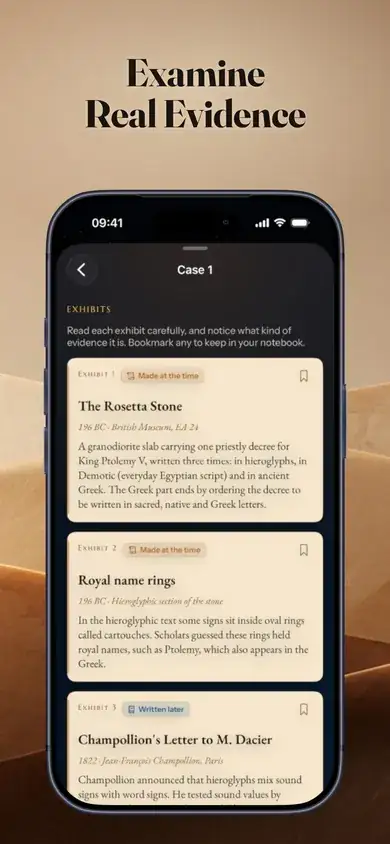
PastRush Case 1 exhibits: the Rosetta Stone labelled made at the time, royal name rings, and Champollion's letter labelled written later
Exhibits, each labelled by what kind of evidence it is.
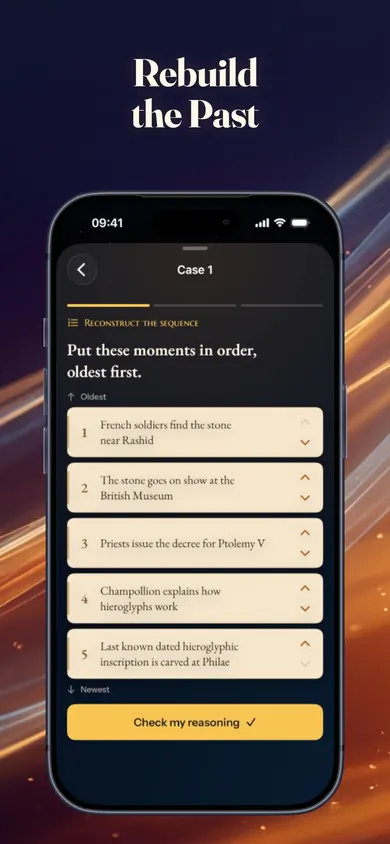
PastRush reconstruct the sequence: five moments from French soldiers finding the stone to the last hieroglyphic inscription, to put in order oldest first
Chronology: put the moments in order, then check your reasoning.
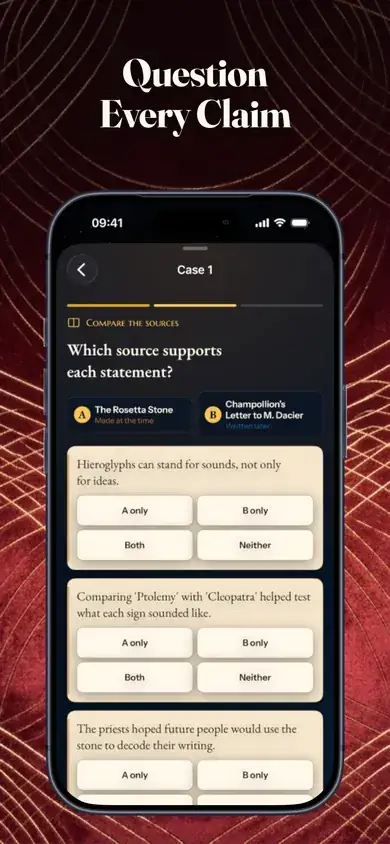
PastRush compare the sources: which source supports each statement, with options A only, B only, Both or Neither
Source comparison: A, B, both, or neither.

How a case works, in three steps

1

Read the exhibits

Each is labelled: made at the time, written later, scientific finding, modern reconstruction. Bookmark any to the Notebook.

2

Do the historian's jobs

Order the events (BC/AD handled correctly), compare sources, link causes to effects, match time and place.

3

Decide what can be concluded

Sort claims into supported and going too far. Every answer explains why and links to the source behind it.

Questions parents ask

What age is PastRush for?

The App Store rating is 9+. The six free cases (Rosetta Stone, Pompeii, Grand Canyon rock layers, Ötzi, continental drift, the Norse in Vinland) read well with a parent beside a nine-year-old and alone from about eleven; the evidence-sorting tasks are closer to what middle-school history asks for.

Is it actually free?

Six of the twelve investigations are free for everyone, along with the globe, Notebook, Daily Evidence Check, Album and the picture games, per the listing. Founder Lifetime is a one-time purchase for cases 7 to 12 and the Master tier; the listing says no subscription and no recurring charges.

Does it need Wi-Fi?

Cases, the Notebook, stories, the Album and ancient-Earth maps work offline. The satellite map, Dive's satellite views, Where in the World? and nearby places need a connection, per the listing.

Are the pictures real?

The listing is unusually direct about this: every exhibit is labelled as made at the time, written later, a scientific finding or a modern reconstruction, and story pictures are AI-assisted illustrations marked as illustrations, never presented as photographs of real objects. Satellite imagery is from Apple Maps.

Can a classroom use it?

Class mode hides purchases and outside links on shared devices; it does not open paid content. No account, no ads, no tracking. Founder Lifetime works with Apple Family Sharing, with progress kept on each device.

Which of the other games should we pick?

For a four-year-old who likes the sea, Deep Blue (subscription). For a teenager on a commute, Paladin's lesson-and-quiz format. For pub-quiz dates, Eventology, though it has not been updated since 2019. For evidence and reasoning rather than recall, ours; that is the whole design difference, and the table shows what each listing claims.

Try it tonight

PastRush: History Detective. Twelve investigations, six free. Real exhibits, labelled. No ads, no account, no tracking. One optional one-time purchase, never a subscription.

Download PastRush: History Detective on the App StoreFree on iPhone and iPad · 9+

Sources

  1. Britannica: Pompeii (24 August AD 79; ash and pumice); Ötzi (found 19 September 1991 by Helmut Simon; about 3300 BC); Rosetta Stone (196 BC); Black Death (1347); Johannes Gutenberg (c. 1450); L'Anse aux Meadows (c. AD 1000); Pyramids of Giza (c. 2560 BC); Woolly mammoth (Wrangel Island survivors to about 4,000 years ago).
  2. English Heritage, History of Stonehenge (henge c. 3000 BC; sarsens c. 2500 BC).
  3. ScienceNorway, No, the Vikings didn't wear helmets with horns.
  4. US App Store listings read 4 November 2026: PastRush: History Detective, Paladin: Learn History, History for Kids: All Civilizations, Deep Blue Archaeology for Kids, Eventology - History Trivia.

Dates are rounded as the sources round them. The quiz avoids pairs where the order is debated.