Pomodoro
- Built for
- Staying on a task in 25-minute blocks with short breaks
- Helps with starting
- Not much; 25 minutes is the wall
- Needs
- A timer
- Cost
- Free
Why can’t I start tasks I actually want to do?
The question most people type at 11 am with the document open and nothing in it. Six myths about starting, checked against named sources; Pomodoro vs the two-minute start vs body doubling, compared; and a twenty-second starter you can run on this page before you read any of it. Now is the app we make for this. It is free and it does not treat anything.
11:04The report is open. The cursor blinks. You have made coffee twice. You know what to write; you cannot begin to write it. This is not laziness; it has a name, and the name is the activation step.
11:06Phone. One task: “write the report”. The suggested first step comes back: “open the template and type the title”. You make it smaller: “type the title”. Start for two minutes.
11:08The ring ends. You typed the title and, because you were already there, the first sentence. Task finished counts. You pick fifteen more minutes because the hard part, the beginning, is behind you.
11:30Two paragraphs. Not the report. The report is not the task today; starting was.
FactStarting is a skill with a name. CHADD describes executive functions that activate, organise and manage other functions, and says impairments affect the ability to begin, work on and complete tasks. A person who cannot start is not lazy; the activate step is the one that is stuck, and it responds to structure, not scolding.
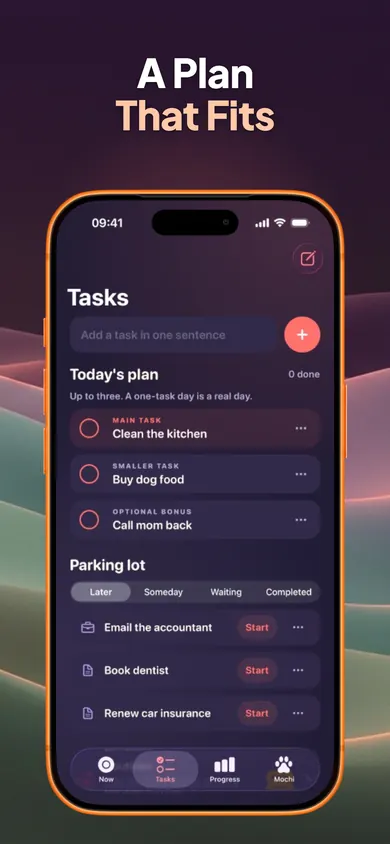
CHADD, Executive Function SkillsFactA list is where tasks go to wait. The thing that moves you is one task with one concrete first step. Now’s screen shows exactly that, and its daily plan holds three tasks, not thirty; everything else waits in a parking lot where nothing is deleted.
App Store listing, 4 Nov 2026FactFor continuing, maybe. For starting, it is a wall. The Pomodoro Technique is 25-minute blocks by design; the two-minute start is a different tool for a different problem, and the two are not rivals. Start with two, then pick 5, 10, 15 or 25.
The Pomodoro Technique; listingFactEnding early still counts, in Now’s own words. A task touched for ninety seconds is a task that exists in your day; the one you never opened is not.
App Store listingFactOnly if it never ends. One first step, small enough to be slightly embarrassing, is the opposite of procrastination. Put five dishes in the sink is a real instruction; clean the kitchen is a mood.
Listing exampleFactNo. Now’s listing says it is a productivity-support tool that does not diagnose, treat or manage ADHD or any medical condition. If starting is impossible most days, that is a conversation with a clinician, not a download.
App Store listing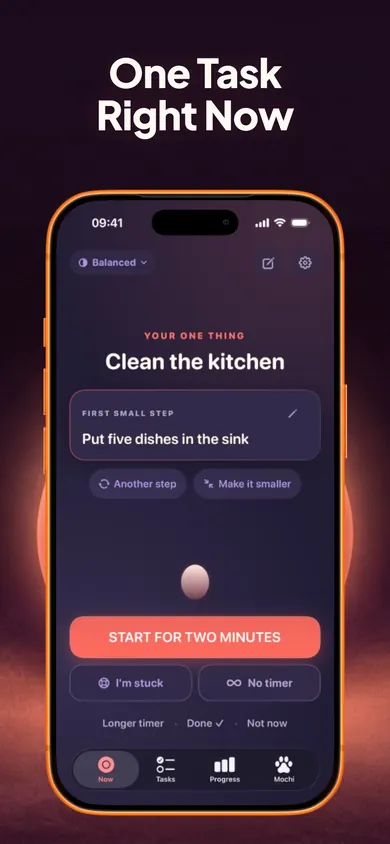
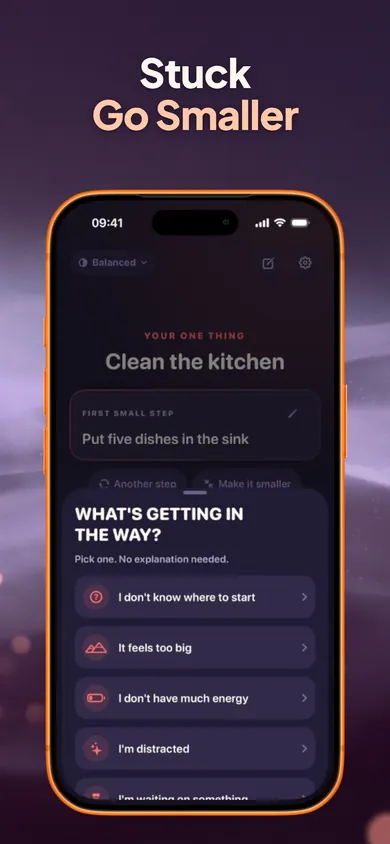
Because starting is its own step, separate from wanting. CHADD’s description of executive function includes activating for tasks as one of the clusters that can be impaired; when it is, the gap between “I should” and “I am” does not close on its own. What closes it is a smaller first step, a visible short timer, and permission to stop. That is the entire design of the two-minute start.
Both, in order. The two-minute start gets you over the activation gap; a Pomodoro-length block (25 minutes) is for staying once you are in. Now does the first by default and offers 5, 10, 15 or 25 minutes, custom, or no timer after it.
Working alongside another person, in a room or on a call, so that their presence makes starting easier. It is widely used in ADHD communities; it needs another human, which is its strength and its limit. No app replaces it; Now’s Mochi companion naps while you focus and is explicitly optional and never needy.
Free forever, per the listing: the one-task screen, two-minute starter, Stuck button, task breakdown, unlimited tasks, Brain Dump, focus timers, daily plan and parking lot, reminders, Quiet Mode and full data export. Pro adds routines, Time Mirror history and insights, full task history with CSV export and Mochi customisation: $4.99 a month, $29.99 a year or $59.99 once.
Yes. Quiet Mode hides Mochi and decoration so you see just the task, the timer and the next step, and there are switches to turn off Sparks and rewards, reduce animations and silence sounds. It respects Reduce Motion and works with VoiceOver and Dynamic Type.
No account; tasks, notes and history stay on the iPhone and can be exported or deleted. Purchases go through Apple with an anonymous identifier to RevenueCat; tasks are never sent, per the listing.
The app does two minutes. This page does twenty seconds, which is enough to prove the mechanic: type the task, accept a smaller first step, press start, do only that.
Runs in your browser; nothing is saved. In Now the ring is two minutes, keeps time when the phone is locked, and ending early still counts.
Now: ADHD Task Starter. One task, one first step, a two-minute ring, a Stuck button. Free forever for the starter, timers, Brain Dump and daily plan. No account.
General information about working habits, not medical advice. If starting is impossible most days, talk to a clinician.