A typical bad week, made up but familiar
Fourth night shift in a row. Home at 8:10, asleep by 9:30, awake at 1:40 because the courier rang. Four hours, maybe. The plan was to run the five-minute test at 3 pm. On a week like this, the honest move is to run it and expect a lower number. The result is not "my attention is bad"; it is "my attention on four hours of daytime sleep is bad", which is a different fact, and a useful one if you keep it next to the rested weeks.
That is the whole point of testing at home rather than once in a clinic: you can collect the tired results and the rested ones, and see how far apart they sit.
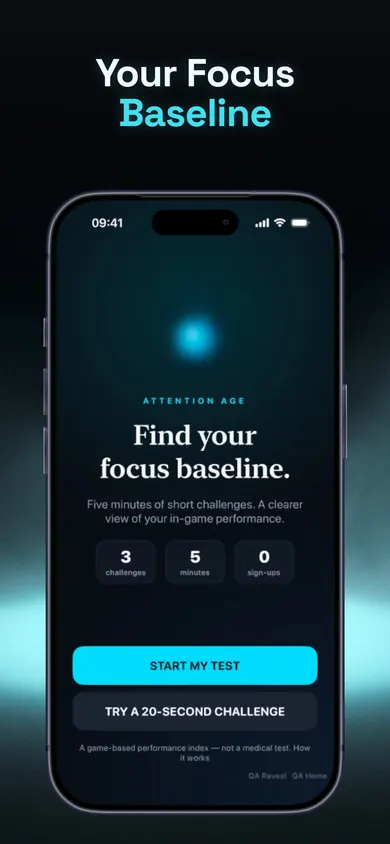
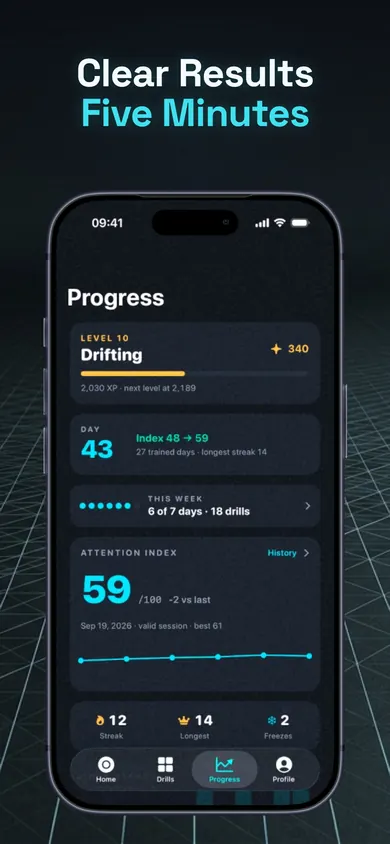
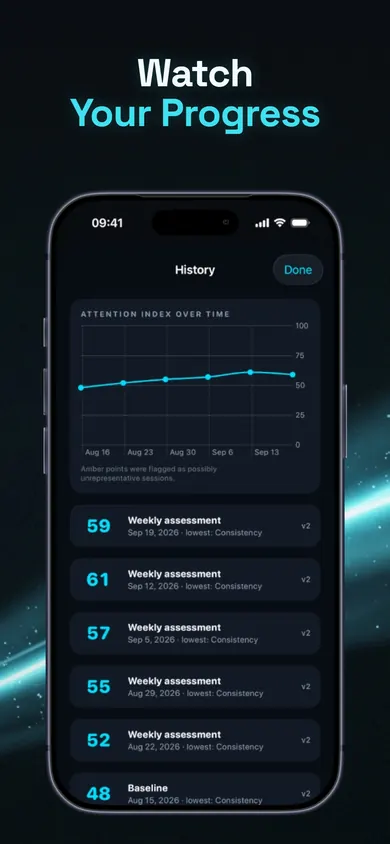
What the test looks like on the phone
How to read your result after short sleep
| Your week | What a score today tells you | What to do with it |
|---|---|---|
| 7+ hours most nights, slept normally last night | A fair baseline on the three tasks | Keep it as your reference week. Re-test weekly on a similar day. |
| Under 6 hours last night, otherwise fine | Mostly a measure of last night | Run it, note "short night", and don't compare it with rested weeks until you have a rested re-test. |
| Under 6 hours on average for a week | A sleep-deprived baseline; sustained attention is the category most likely to drop | Take it anyway (lower results stay in history), then re-test after two 7+ hour nights. A rise then is recovery, not training. |
| Rotating shifts, test time varies | Time of day adds its own swing | Test at the same point in your shift cycle each week. The app lets you pick any day for the weekly re-test. |
Short-term sleep loss hits sustained attention harder than most other measured skills: a 2010 meta-analysis of 70 studies by Lim and Dinges found the largest effects on simple vigilance tasks, the kind of task Signal Watch resembles. The app's "about the same" rule for changes under 5 points keeps you from reading a tired dip as a trend.
Who should pick something else
Anyone looking for a diagnosis
The Attention Index is not a clinical measure and the app does not claim otherwise. If you are worried about ADHD, concussion or a sleep disorder, a clinician can run validated tests. This app is for practice and tracking.
People who want a leaderboard
There are no rankings and no fake competitors. The Daily Signal gives everyone the same 20-second pattern on the same date and a shareable result grid, and that is as competitive as it gets.
Kids
The tasks and copy are written for adults. It collects nothing, but it is not designed as a children's game.
Questions tired people ask
How do I test my attention span at home?
Use a timed task with a fixed scoring rule and repeat it under similar conditions. Online quizzes that ask how you feel measure mood, not attention. Attention Age runs three timed tasks on your iPhone in about five minutes, scores them on a 0 to 100 index with five category scores, and keeps every result so you can compare week to week.
Will a bad night's sleep change my score?
Expect it to. Short-term sleep loss has its largest measured effect on sustained attention and vigilance (Lim and Dinges, 2010 meta-analysis). That is why this page starts with a sleep check: a score taken after four hours of sleep tells you about that night, not about your attention in general.
How many hours of sleep count as enough?
The CDC's recommendation for adults aged 18 to 60 is seven or more hours per night. Shift workers often get less on work days and sleep in daylight, which is lighter and more broken, so a weekly average is a better guide than any single night.
Is the Attention Index a medical score or an ADHD test?
No. The app says so itself: it is an entertainment and self-practice app, the index reflects performance on these specific tasks on this device, and it is not an age, a percentile, a ranking or a diagnosis. If attention problems are affecting work or safety, talk to a clinician.
Why does the app call a 3-point change 'about the same'?
Because small day-to-day swings are mostly noise: sleep, caffeine, mood, how carefully you tapped. Attention Age treats changes under 5 points as 'about the same' and flags early gains that probably come from learning the tasks rather than from better attention.
Does the app need an account or send my data anywhere?
No account, no ads, no third-party analytics, per the listing. Results stay on the iPhone; you can export them as CSV or delete everything from Settings. Deep Work sessions can optionally be written to Apple Health as Mindful Minutes.
Download free on the App Store
Attention Age: three tasks, five minutes, every result kept. The weekly re-test is always free. No account.
Sources
- CDC, About Sleep: how much sleep adults need (7 or more hours for ages 18 to 60), read 4 November 2026.
- Lim J, Dinges DF. A meta-analysis of the impact of short-term sleep deprivation on cognitive variables. Psychological Bulletin. 2010;136(3):375-389. PubMed.
- NHLBI, Sleep deprivation and deficiency, read 4 November 2026.
- Attention Age App Store listing, version 1.2, read 4 November 2026.