Tuesday, told twice
A made-up evening, but a familiar one. Same person, same flat, same laptop. The left column is how it goes; the right is the same night with a four-minute ending.
Without an ending
Last meeting ends. Laptop stays open "for one more thing".
Dinner at the desk. Slack still pinging; replies to two of them.
Closes the laptop. The evening is finally here, and it feels short already.
Bedtime was supposed to be eleven. The phone comes out "for ten minutes".
Still up. Not tired exactly; just not finished with the day that never properly ended.
Six hours, maybe. Tomorrow starts with the tabs still open.
With an ending
Opens Sleepward. Step 1, Brain Dump: "email Sam", "fix the invoice", "mum's birthday", "the thing about the lease". Four entries, parked.
Step 2: tomorrow's three. Main thing: the invoice. Small task: email Sam. Optional: nothing. Everything else stays parked.
Step 3: Your Hour, 60 minutes, countdown hidden. The evening has a shape: 9:20 to 10:20, and it is hers.
The hour ends on its own. Wind-down: screen darkens, brown noise, 15-minute fade.
Phone face down. Bedtime was eleven; it is close enough.
Eight hours. The morning check-in is one tap, four faces, no number.
Nothing in the second column needed willpower at midnight. The decisions were made at 9:15, when there was still some left.
Who should pick something else
If you suspect a sleep disorder
Insomnia that persists, loud snoring, or waking unrefreshed for weeks are clinician questions. Sleepward is a routine app, not a treatment. This page is general information, not medical advice.
If you want sleep stages and scores
Sleepward refuses to score sleep on purpose. A wearable and its app will give you numbers; this will give you an evening.
If the problem is the job, not the evening
An ending to the day only works if the day is allowed to end. If replies at 11 pm are expected, that is a boundary conversation, and an app cannot have it for you.
What people try, and what each one changes
| Approach | What it changes | Where it fails at 11:40 pm |
|---|---|---|
| Willpower, a strict bedtime | Nothing structural | Decisions made tired are the problem it is trying to solve |
| Phone screen-time limits | Removes the scroll | Leaves the unfinished day; you find another screen |
| Sleep tracker with scores | Measures the damage | A bad score the next morning does not give the evening back |
| Sleepward: reset, Your Hour, wind-down | Gives the day an ending and the evening a protected window | If you skip the 9:15 reset, nothing stops the midnight scroll; it only works if you open it before you are tired |
Plan tonight backwards from your alarm
Enter the time you need to be up and how long you want your evening. The planner works back through wind-down and Your Hour to the time to open the app, and shows what a seven-hour night asks of you.
In the app, Your Hour always ends before the bedtime you chose and you can change the times any evening. Guideline: 7+ hours for adults 18 to 60 (CDC).
Questions people ask at 11:40 pm
What is revenge bedtime procrastination?
Putting off sleep to reclaim personal time you did not get during the day, even though you know tomorrow will suffer. The research term is bedtime procrastination, introduced by Kroese and colleagues in 2014; the "revenge" framing came from Chinese social media and spread in 2020. Working from home makes it worse because the workday has no physical ending.
How does Sleepward help with it?
By giving the day an ending and the evening a protected shape. A four-minute reset (Brain Dump, pick tomorrow's three things), then Your Hour, a stretch of personal time of 15, 30, 45 or 60 minutes that always ends before the bedtime you chose, then a darkening wind-down with free white, pink or brown noise.
Does it track or score my sleep?
No scores, ever, per the listing. You can optionally log approximate bed and wake times and how you felt, or read sleep from Apple Health (it never writes to Health), and you can hide all numbers. Grace Nights mean nothing resets when you miss an evening.
Is it free?
The evening reset, Brain Dump, tomorrow's three things, Your Hour, wind-down, routines, Minimal Mode, sleep logs, Apple Health reading, morning check-ins, white/pink/brown noise, daily Moon Gifts, the Star Atlas, the Moon Fox and the first world chapter are free forever. Pro adds the remaining 12 world chapters, the Chronicle, studio-recorded soundscapes and more.
How much sleep should I be aiming for?
The CDC's guideline for adults aged 18 to 60 is seven or more hours a night. The planner above works backwards from your wake time so you can see what a 7-hour night requires of your evening.
Will it wake me up?
It can send an optional wake-up reminder, but that is a time-sensitive notification, not a system alarm; Silent mode or a Focus can quiet it. Keep your Clock alarm for anything that matters.
The three steps, tinted
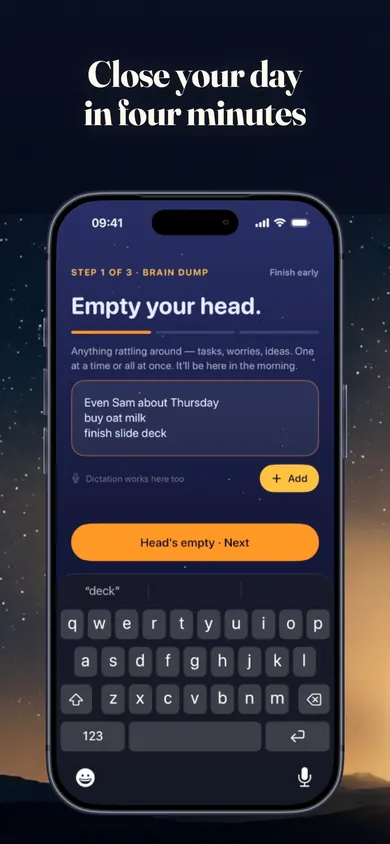
Step 1: Brain Dump, as separate entries you can edit later.
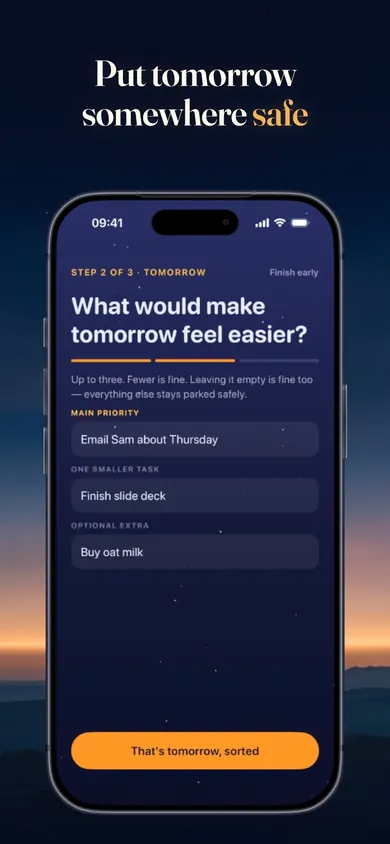
Step 2: tomorrow's three. Fewer is fine. None is fine.
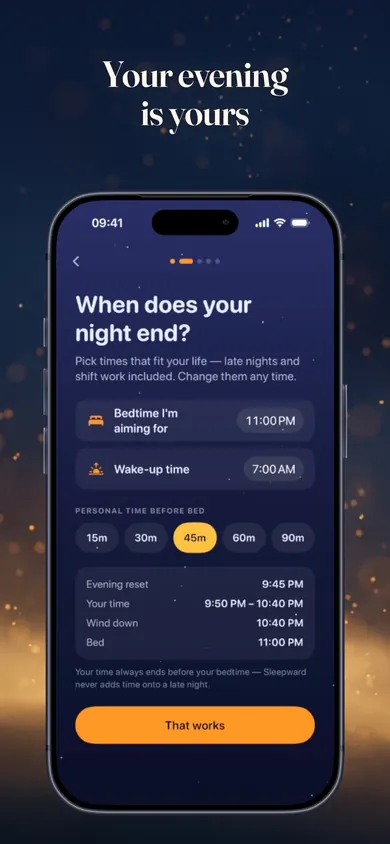
Step 3: Your Hour, and the plan for the night, in order.
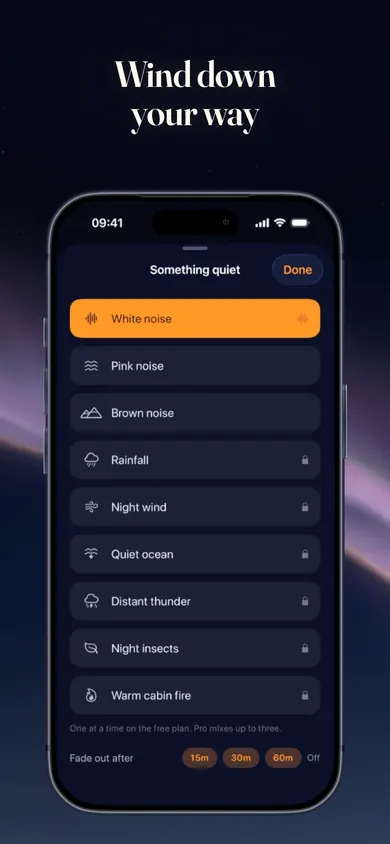
Wind-down: white, pink and brown noise free, with a fade-out timer.
Try it tonight
Sleepward: a four-minute evening reset, a protected hour that ends before bed, and a wind-down that never scores you. Free, no account.
Sources
- Kroese FM, De Ridder DTD, Evers C, Adriaanse MA. Bedtime procrastination: introducing a new area of procrastination. Frontiers in Psychology. 2014;5:611. PubMed.
- CDC, About Sleep: how much sleep adults need (7 or more hours, ages 18 to 60), read 4 November 2026.
- Sleepward: Bedtime Routine, App Store listing, version 1.1.0, read 4 November 2026. Feature and free/Pro statements come from this text. The Tuesday scenario is invented.
General information, not medical advice. Persistent sleep problems are a question for your clinician.