Advent 2026 · updated November 2026

Stop quoting the Christmas card. Start with Luke 2 and Matthew 2.

The Christmas story in the Bible in order: ten stops from Nazareth to Egypt, Matthew and Luke side by side, every stop tied to the verse that says it, in the World English Bible. Then scratch eight Christmas-card details and see which ones are in the text. From the studio behind Wayfold, the chapter-by-chapter study app that labels every claim In the text, History, Interpretation, Traditions differ or Debated.

Download Wayfold: Understand the Bible on the App StoreOpen Wayfold in the App Store · free to start
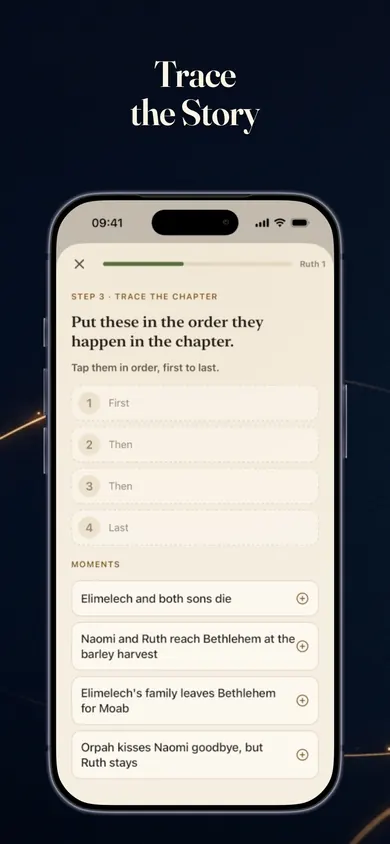
Wayfold Trace: put the chapter’s main events in the order they happen, each tied to the verse where it happens

Two Gospels tell the birth. Neither mentions a stable, an innkeeper, a donkey, three kings or a date. Here is what they do say, in order.

  1. Luke

    Nazareth: Gabriel comes to Mary

    Luke 1:26-38, World English Bible

    “Behold, you will conceive in your womb and give birth to a son, and shall name him ‘Jesus.’” (1:31)

    In the text
  2. Luke

    The hill country: Mary with Elizabeth

    Luke 1:39-56, World English Bible

    “Mary arose in those days and went into the hill country with haste, into a city of Judah.” (1:39)

    In the text
  3. Matthew

    Joseph’s dream

    Matthew 1:18-25, World English Bible

    “You shall name him Jesus, for it is he who shall save his people from their sins.” (1:21). Matthew tells the announcement from Joseph’s side; Luke from Mary’s.

    In the text
  4. Luke

    The census: Nazareth to Bethlehem

    Luke 2:1-5, World English Bible

    “A decree went out from Caesar Augustus that all the world should be enrolled.” (2:1) Joseph goes up “to David’s city, which is called Bethlehem” (2:4), with Mary, “being pregnant” (2:5). No donkey is mentioned.

    In the text
  5. Luke

    The birth

    Luke 2:6-7, World English Bible

    “She wrapped him in bands of cloth and laid him in a feeding trough, because there was no room for them in the inn.” (2:7) A feeding trough, an inn with no room. No stable, no innkeeper, no animals in the verse.

    In the text
  6. Luke

    The shepherds and the heavenly army

    Luke 2:8-20, World English Bible

    “There were shepherds in the same country staying in the field, and keeping watch by night over their flock.” (2:8) Then “a multitude of the heavenly army praising God and saying, ‘Glory to God in the highest…’” (2:13-14). Saying, in the text; singing is tradition.

    In the text
  7. Luke

    Day eight: named Jesus

    Luke 2:21, World English Bible

    “When eight days were fulfilled for the circumcision of the child, his name was called Jesus, which was given by the angel before he was conceived in the womb.”

    In the text
  8. Luke

    Jerusalem: Simeon and Anna

    Luke 2:22-39, World English Bible

    “They brought him up to Jerusalem to present him to the Lord” (2:22). Afterwards, in Luke, “they returned into Galilee, to their own city, Nazareth” (2:39).

    In the text
  9. Matthew

    The wise men, Herod, the star, the house

    Matthew 2:1-12, World English Bible

    “Wise men from the east came to Jerusalem” (2:1). The star “went before them until it came and stood over where the young child was” (2:9). “They came into the house and saw the young child with Mary” (2:11). No number of wise men; three gifts.

    Debated: when
  10. Matthew

    Egypt by night, then Nazareth

    Matthew 2:13-23, World English Bible

    “He arose and took the young child and his mother by night and departed into Egypt” (2:14). Herod kills the boys “from two years old and under, according to the exact time which he had learned from the wise men” (2:16). Later they “came and lived in a city called Nazareth” (2:23).

    In the text

Order within each Gospel is the Gospel’s own. How Luke’s temple visit and Matthew’s wise men and Egypt fit together is not stated in either book, which is why that stop is marked Debated, the same label Wayfold uses in its notes.

Scratch the Christmas card

Eight things everyone knows about the first Christmas. Scratch each one to see whether it is in the text, a tradition, or neither.

  • Not in the text

    Matthew 2:1 says “wise men from the east”. No number; no “kings”; and by 2:11 they come “into the house”. The three comes from the three gifts: gold, frankincense, and myrrh.

  • Not in the text

    Luke 2:7: “because there was no room for them in the inn.” An inn, no innkeeper. Every innkeeper in every nativity play is an addition.

  • Not in the text

    Luke says “feeding trough” three times (2:7, 2:12, 2:16) and never says stable, ox or donkey. A trough implies animals somewhere; the text stops there.

  • Traditions differ

    Luke 2:13: “a multitude of the heavenly army praising God and saying”. Saying, in the World English Bible and the Greek. Singing is how the church has heard it for centuries.

  • Not in the text

    Luke’s shepherds find a baby in a feeding trough (2:16). Matthew’s wise men find a “young child” in “the house” (2:11), and Herod targets boys two and under from the time the star appeared (2:16). How long after, the text does not say.

  • Not in the text

    Luke 2:4-5: Joseph “went up from Galilee… to enroll himself with Mary… being pregnant.” How they travelled is not recorded.

  • Not in the text

    Neither Gospel gives a date or a season. The shepherds were “in the field… by night” (Luke 2:8); that is all the weather report there is.

  • In the text

    Matthew 2:9: the star “went before them until it came and stood over where the young child was.” That one is in. Over a house, not a stable.

Matthew and Luke, honestly compared

Matthew 1-2Luke 1-2
The announcement goes toJoseph, in a dream (1:20)Mary, from Gabriel, in Nazareth (1:26-31)
Where the family startsNot said before the birth; Bethlehem “in the days of King Herod” (2:1)Nazareth, travelling to Bethlehem for the census (2:4)
VisitorsWise men from the east, into “the house” (2:1, 2:11)Shepherds from the fields, to the feeding trough (2:8-16)
A sign in the skyA star (2:2, 2:9)An angel, then the heavenly army (2:9-14)
The threatHerod; the boys of Bethlehem; flight to Egypt (2:13-18)None recorded
AfterwardsEgypt, then Nazareth (2:14, 2:23)Day eight naming, Jerusalem temple, then Nazareth (2:21-39)
Both agreeMary and Joseph, engaged; conception by the Holy Spirit; the name Jesus given by an angel before birth; born in Bethlehem; raised in Nazareth; David’s line.

Who this is not for

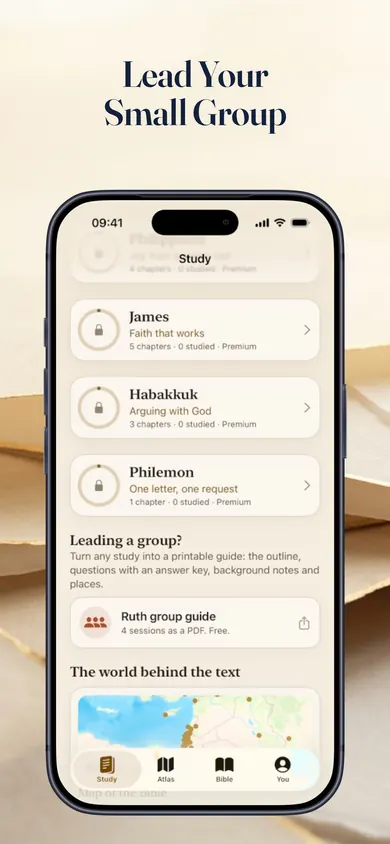
  • Anyone who wants a paraphrase.Wayfold quotes the World English Bible word for word, never a retelling. If you want the story in modern prose, that is a different kind of book.
  • Anyone expecting all four Gospels.Only Matthew and Luke tell the birth. Mark begins with John the Baptist; John begins before creation. The app will not invent a Mark 1 nativity for you.
  • Anyone who wants the app to settle the debates.Where the two accounts’ timing is uncertain, Wayfold says Debated and shows the sources. It does not pick a side for you.
  • Small children on their own.It is a study app for adults and groups. Parents can read the chapter aloud from it, with the built-in voice if they like.

Honest limits

Matthew and Luke are not among the six study books.

Wayfold’s guided studies are Ruth and Jonah (free) and Philippians, James, Habakkuk and Philemon (Premium Lifetime). Matthew 1-2 and Luke 1-2 you read in the full offline Bible reader, with the places in each chapter on the map and the word notes tappable; there is no question set for them.

The map needs a connection for tiles.

The reader, the Bible text, notes and timeline work offline; Apple Maps tiles do not. The 64 key places carry a label for how sure scholars are of the location.

One translation.

Everything is the World English Bible, public domain, bundled on the device. Protestant (66 books) and Catholic (73 books) canons are both included; choose yours.

We make it.

Honest Little Apps is the studio behind Wayfold. The two chapters are free in any Bible; the app adds the labels, the map, the journeys and the group guides.

Trace it yourself

Wayfold’s Trace exercise asks you to put a chapter’s events in order, each tied to its verse. Here is the same idea for the Christmas story: tap the eight events in the order they happen, then check. Scoring happens on this page only; nothing is saved.

    0 of 8 placed

    A made-up Sunday in Advent

    4:10 pmSomeone at the table says the wise men were kings and there were three of them. Someone else says the innkeeper was cruel. The phone comes out, not to win, but to look.

    4:12 pmWayfold, reader, Matthew 2. “Wise men from the east.” No number. The place note for Bethlehem opens on the map with its label for how sure scholars are. Back to Luke 2: “no room for them in the inn.” No innkeeper anywhere.

    4:20 pmThe chapter read aloud by the phone while the potatoes go in. Then the notebook: one entry, two lines, “feeding trough ×3, stable ×0”.

    LaterThe timeline in the app has 27 events, each marked firm, approximate, traditional or debated. The birth of Jesus is on it. The date is not, because the text does not give one.
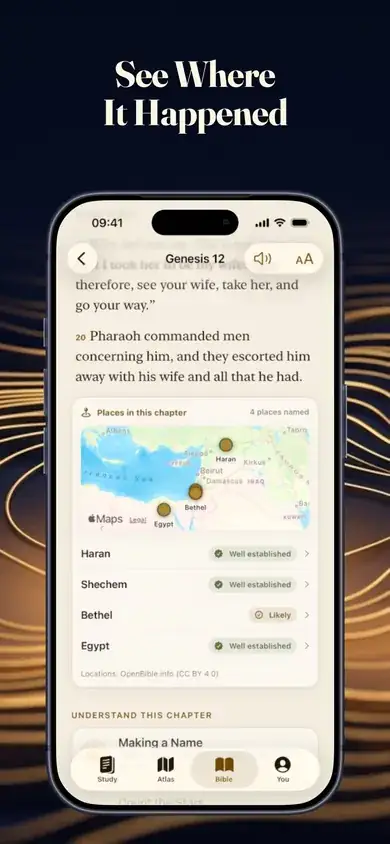
    Wayfold Bible map showing places named in a chapter, each labelled with how sure scholars are of the location
    Places in the chapter, with a confidence label.
    Wayfold Go deeper notes, each marked as what the text says, history, interpretation or debated
    Every explanation carries its label.

    How Wayfold reads a chapter

    1. Read it, or hear it

      The full chapter, World English Bible, offline, with the device voice and a sleep timer if you want it read to you.

    2. Answer, then see the words

      In the six study books, a few questions about what happened, then the exact words in the chapter that answer each one. Trace puts the events in order, each tied to its verse.

    3. Go deeper, labelled

      Short notes on history, language and meaning, each marked In the text, History, Interpretation, Traditions differ or Debated, with sources named.

    Open Wayfold in the App Store

    Free: Ruth and Jonah with their leader guides, the complete offline Bible with read-aloud and search, the map, the timeline, four journeys and seven lessons. One optional lifetime purchase adds the rest. No account, no ads, no tracking.

    Download Wayfold: Understand the Bible on the App StoreFree on iPhone · iOS 18 or later

    Sources

    1. Luke 1-2 and Matthew 1-2, World English Bible (public domain). Verses quoted word for word; checked November 2026 against the WEB text at Bible Gateway (Luke 2, WEB) and Matthew 2, WEB.
    2. Wayfold: Understand the Bible, App Store listing, version 1.1, read November 2026. Study books, labels, map, timeline and free-tier details are quoted from it.