A glossary, with a calculator · winter 2026 · updated November 2026
The summit sunset, minus the walk down in the dark.
Dear person who typed golden hour vs blue hour into a search box with a hill in mind,
Every winter sunset walk is two questions: when is the light good, and when does it get dangerous. Photographers care about the first; hikers who have done the descent by phone torch care about the second. The words below answer both, and the calculator gives the times for your date and place without an account. Asterfold is the app we make for the same problem; it appears where it is relevant and is not required.
Calculated on the phone, offlineForecast and observed labelled apartFlat horizon assumed, says so
Your light window and your headlamp time
Standard solar-position equations, sea level, flat horizon. Times are shown in your browser's time zone, so for a place in another zone add the difference. Defaults are London; type your own coordinates (your phone's Maps app shows them when you drop a pin). Nothing is sent anywhere.
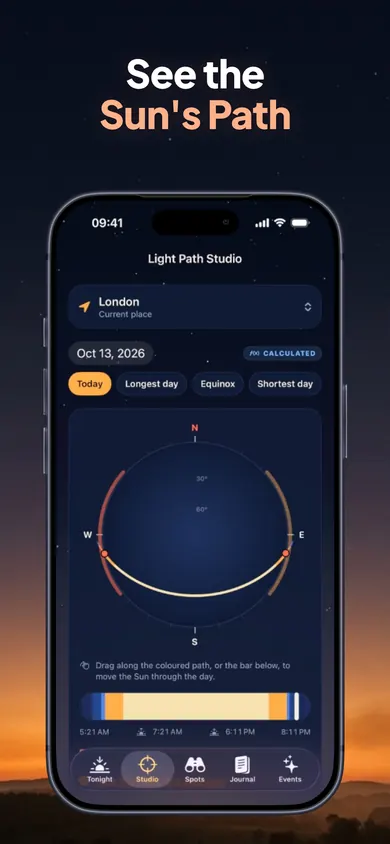
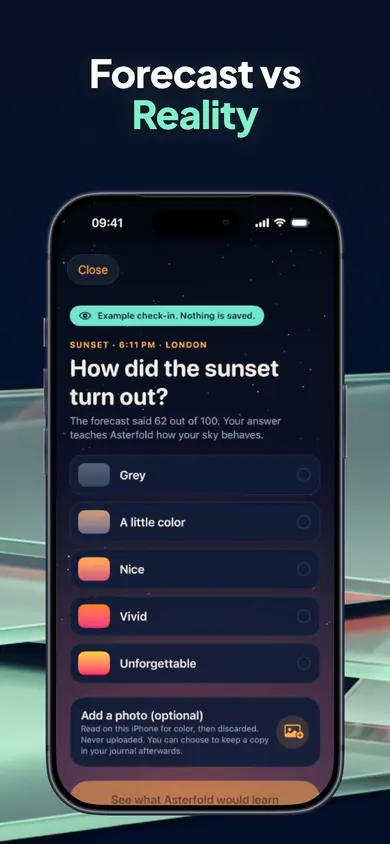
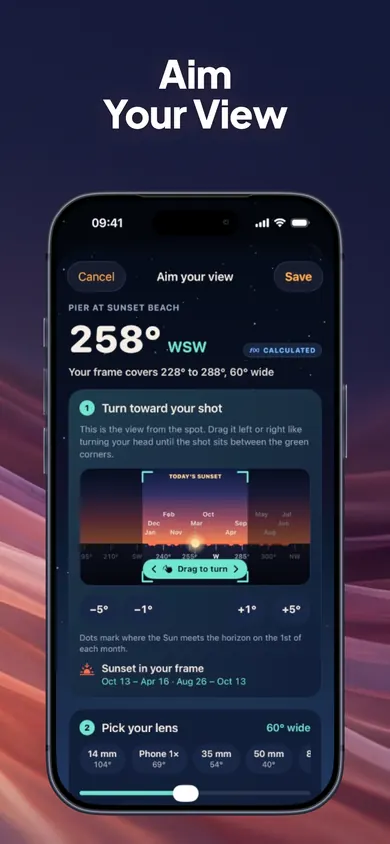
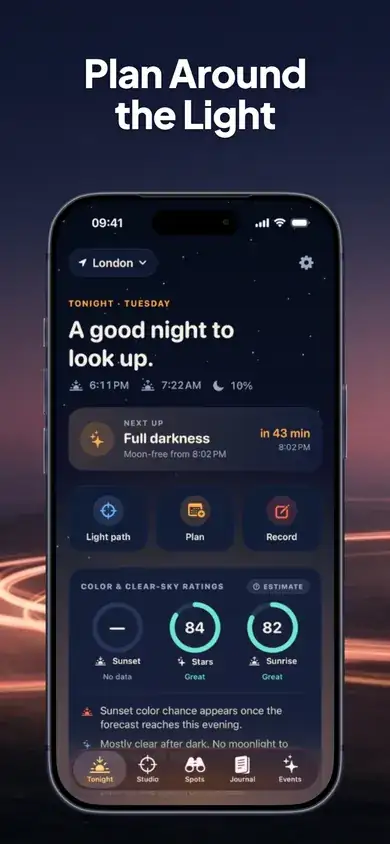
Asterfold: the Sun's path, aiming a viewpoint, tonight's ratings, the forecast-versus-reality check-in.
21 December, made up but familiar
2:10 pmThe year's most southerly sunset. The calculator says sunset 3:53, headlamp time 4:34. You set off with that second number written on your hand.
3:20 pmGolden hour has already started; in December it is a forty-minute affair that begins while the Sun still feels high. The low cloud to the west that the app flagged at lunchtime has thinned.
3:53 pmSunset, 231° on the compass, exactly where the viewpoint you saved in October said it would be. You turn round for the Belt of Venus. Nobody else does.
4:12 pmBlue hour. The town lights come up to meet it. Two more frames.
4:30 pmHeadlamp on, four minutes early, walking. Civil twilight ends while you are already below the scree. That is the whole point of the second number.
Who should skip it
People who want a general weather app. Asterfold is a sunset planner with cloud layers; it is not a forecast for your Tuesday.
Anyone whose view has a ridge to the west. Sun positions assume a flat horizon; hills, buildings and trees are not modelled, per the listing. The times will be optimistic. Use them as an upper bound.
Android. iPhone, iOS 18 or newer.
Anyone treating a rating as a promise. The listing calls ratings a rule-of-thumb estimate, not a probability or a guarantee. Clouds do what they like.
The glossary
Golden hour
The stretch when the Sun is low: by the convention most planning apps use, from about 6° above the horizon to 4° below it. Warm, long shadows, soft contrast. In December at mid-northern latitudes it is short and early; the calculator above gives yours.Convention; the exact angles vary by source.
Blue hour
After sunset (and before sunrise), roughly while the Sun is 4° to 6° below the horizon: the sky goes deep blue, city lights balance it. Golden hour vs blue hour is a question of which side of the horizon the Sun is on.Convention, as above.
Civil twilight, or headlamp time
Ends when the Sun is 6° below the horizon. Until then you can usually still see the trail without a light; after it, you cannot. For hikers this is the number that matters more than sunset.USNO definition.
Nautical and astronomical twilight
Sun 12° and 18° below. Nautical: horizon still visible at sea. Astronomical: the sky is fully dark for stars. Only the second one matters for the Milky Way; neither matters for walking down.USNO definitions.
Sunset bearing, or azimuth
The compass direction the Sun sets in, measured from north. It swings through the year: furthest south around 21 December, furthest north around 21 June. A summit that faces 250° gets a clean December sunset and a blocked June one.Geometry; Asterfold draws the year's range on its sky dome.
Solar altitude
How high the Sun is above the horizon in degrees. All the words above are just altitudes with names.
Alpenglow
The pink-red light on peaks after the Sun has set at your spot but not yet at the summit's height. Lasts minutes. Needs clear air to the west.
Belt of Venus and Earth's shadow
Opposite the sunset: a pink band above a blue-grey one rising from the horizon. The blue-grey is the Earth's own shadow on the atmosphere. Turn around at sunset; most people never do.
Cloud cut-off
Low cloud far to the west can block the Sun before it reaches your horizon even when your sky is clear. Asterfold checks point forecasts 60 km and 180 km toward the setting Sun for exactly this, per its listing.
Flat horizon
What every calculator, including the one above and the app, assumes. Hills, buildings and trees are not modelled; a ridge to the west takes minutes off everything.
Questions
What is the difference between golden hour and blue hour?
Which side of the horizon the Sun is on. Golden hour is the low-sun stretch around sunset and sunrise, warm and long-shadowed; blue hour is the short window after sunset (or before sunrise) when the Sun is a few degrees below and the sky turns deep blue. The calculator above gives both for your place and date; the glossary gives the angles.
When should a winter hiker start walking down?
At the end of civil twilight at the latest, which is when the Sun reaches 6° below the horizon; in December that can be as little as 30 minutes after sunset at mid-northern latitudes and longer further north. Have the headlamp on before that, not after. The calculator above labels it headlamp time.
Why are December sunsets so far south?
The Sun's setting direction swings through the year, furthest south around the 21 December solstice. A viewpoint that frames a June sunset may not frame a December one. Asterfold's Studio draws the year's range of sunset directions on the rim and has a shortcut to the year's most southerly sunset.
Is the calculator on this page accurate?
To within a few minutes for sea-level, flat-horizon conditions; it uses standard solar-position equations in your browser and your browser's time zone. Refraction and altitude add minutes either way. Hills to the west take more. For planning a walk down, round towards caution.
What does Asterfold add to a sunset time?
Per the listing: the Sun's real path on a sky dome for any place and date; a first-person horizon you aim your viewpoint on, with lens framing; the dates the Sun sets inside your frame; tonight's ratings with cloud at three heights from MET Norway and the 60 km and 180 km cloud check toward the Sun; and a journal that compares what you saw with the forecast it saved beforehand.
Is Asterfold free?
Free includes the Studio, aiming and plans for 2 viewpoints, the journal, check-ins and tuning, tonight's ratings, the next 3 evenings and 45 days of events, per the listing. Plus adds unlimited viewpoints, smart sky alerts, the full 10-day outlook and a year of sky events, yearly with a trial, monthly, or a one-time Lifetime.
How a planned sunset works in the app
Save the spot you actually stand on.Then turn toward your shot on a first-person horizon and pick a lens; the frame narrows or widens to match.
See when the Sun sets inside the frame.The dates this year, plus the next seven sunsets against your view, and the year's most northerly and southerly sunsets one tap away.
Check tonight, then record what happened.Cloud at three heights, the 60 km and 180 km cut-off check, then a two-tap rating after sunset compared with the forecast saved before it. After three check-ins the ratings tune to your sky, in small capped steps.
Aim: the bearing, the frame, the lens. Hover for colour.
Tonight: ratings with plain reasons, and full darkness countdown.
Four ways to know when the light is good
The weather app's sunset time
Gives you
One time
Headlamp time
No
Direction
No
Cost
Free
This page's calculator
Gives you
Golden hour, sunset, blue hour, civil, nautical, astronomical, bearing
Headlamp time
Yes
Direction
Yes, as a number
Cost
Free, no account
A printed twilight table
Gives you
Civil twilight by date, reliably
Headlamp time
Yes
Direction
No
Cost
Free from an almanac
Asterfold (ours)
Gives you
All of the above on a sky dome, plus your framed view, cloud at three heights, the far-west cut-off check, and a journal that grades the forecast
Headlamp time
Full darkness countdown
Direction
On a first-person horizon you turn
Cost
Free for 2 viewpoints; Plus optional
Turn round at sunset, Honest Little Apps
Get Asterfold free
Asterfold: Sunset Planner. The Sun's real path for any place and date, a viewpoint you aim, tonight's ratings with reasons, and a journal that remembers what the forecast said. No account, no analytics.
U.S. Naval Observatory, Rise, Set, and Twilight Definitions: sunset at an apparent altitude of −0.833° (34′ refraction plus the Sun's semidiameter); civil, nautical and astronomical twilight at 6°, 12° and 18° below the horizon.
NOAA Global Monitoring Laboratory, Solar Calculator: the equations behind the in-page calculator (equation of time, declination, hour angle).
Asterfold: Sunset Planner on the App Store, listing read 4 November 2026 (version 1.0.0): Studio, aiming, Tonight, journal, honesty labels, free tier and Plus, data sources (MET Norway, GeoNames, Astronomy Engine).
Golden hour and blue hour angles (6° above to 4° below; 4° to 6° below) are a widely used convention, not a standard. The calculator is for planning, not for safety-critical decisions; carry a light regardless.