Updated November 2026 · three taps, one bearing

The three-minute way to find where the Sun sets from your window

Moved in, or just never checked? Here is how to find where the sun sets from a window, a balcony or a roof, and which of three methods fits your evening. Three taps gives you a bearing to compare with a compass app.

Tap 1 of 3

Where are you watching from?

Tap 2 of 3

Roughly how far from the equator?

Tap 3 of 3

Which sunset do you care about?

Download Asterfold: Sunset Planner on the App StoreAsterfold · free on iPhone

The Sun does not set in the west. It sets somewhere in an 80-degree arc of west, and which end depends on the month.

A made-up Tuesday, new flat

6:10 pmThe balcony faces “sort of west”, said the agent. The Sun is dropping behind the block opposite, well to the left of where the chairs point.

6:12 pmCompass app: the balcony faces 275°. Tap, tap, tap above: mid latitudes, tonight, early November, sunset bearing about 245°. So the Sun is 30 degrees left of straight-on, which is where it is. In June it will be about 30 degrees to the right, clear of the block.

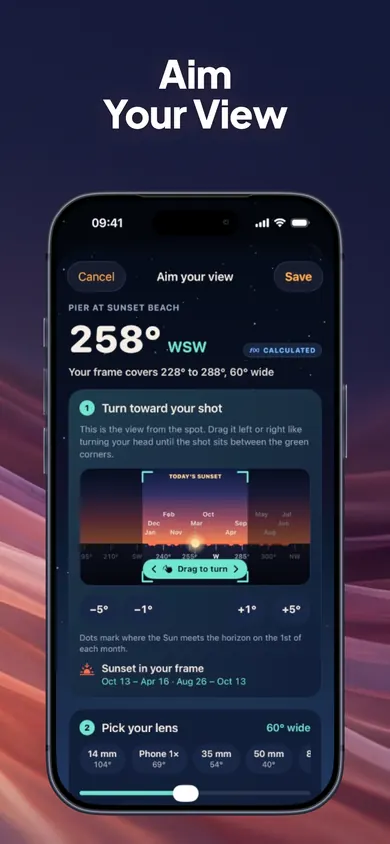
6:15 pmAsterfold, new viewpoint, saved from the balcony. Turn the phone toward the gap between the buildings; the first-person horizon shows the frame, the Sun’s path, and the list of dates this year when the Sun sets inside that frame. The chairs get moved.

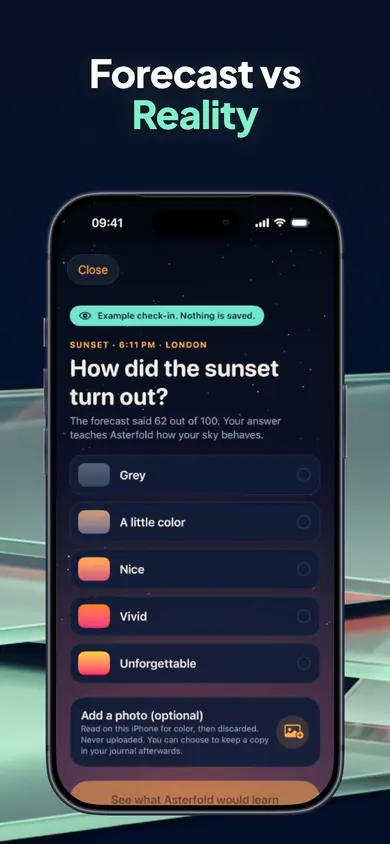
LaterTwo taps after sunset to rate what the sky did, compared with the forecast the app saved beforehand, never a later one.

The flat is invented. The bearings are from the formula on this page; the app features are the ones the listing names.
Three methods, side by side

  • 1. Watch and mark

    How
    Stand at the spot at sunset. Note where it drops against a landmark. Repeat for a few evenings.
    Takes
    A week of clear evenings
    Handles buildings
    Yes, perfectly; it is the only method that does
    Tells you about other months
    No
    Cost
    Nothing
  • 2. Compass rule

    How
    Read the facing with a compass app. Compare with the sunset bearing for the date, from the quiz above or any sunset-azimuth table.
    Takes
    Three minutes
    Handles buildings
    No, flat horizon
    Tells you about other months
    Yes, one date at a time
    Cost
    Nothing
  • 3. Asterfold, aim your view

    How
    Save the exact spot, turn toward the shot on a first-person horizon, pick a lens or the phone camera.
    Takes
    A few minutes, then it is saved
    Handles buildings
    No, flat horizon, as the listing states
    Tells you about other months
    Yes: the dates this year when the Sun sets inside the frame, and the next seven sunsets against it
    Cost
    Free for two viewpoints; Plus for unlimited

Our pick: use method 2 or 3 to learn the month, then method 1 on the day. None of them replaces looking.

Honest limits

Flat horizon only.

Asterfold’s Sun positions assume a flat horizon; hills, buildings and trees are not modelled. For a city window that is the whole question, so pair it with watching.

Ratings are a rule of thumb.

Tonight’s Sunset, Stars and Sunrise ratings are an estimate with plain-English reasons, not a probability or a guarantee, per the listing. Forecast cloud comes from MET Norway.

Two viewpoints free.

Free: the Studio, aiming and plans for two viewpoints, the journal, check-ins, tonight’s ratings, the next three evenings and 45 days of events. Plus adds unlimited viewpoints, sky alerts, the 10-day outlook and a year of events.

We make it.

Honest Little Apps is the studio behind Asterfold. The two free methods above work without it, and we said so.

Questions from the window

Which direction does the sun set?

West, roughly, and the roughly matters. At the equinoxes in March and September it sets almost due west everywhere. Between them it swings: at London’s latitude the sunset point moves from about 230° (south-west) on 21 December to about 310° (north-west) on 21 June, an 80-degree swing. Nearer the equator the swing is smaller; further north or south it is larger.

Does the sun set in the same place every day?

No. It moves a little each day, fastest around the equinoxes and slowest around the solstices, when it pauses and turns back. That is why a window that catches the sunset in November can miss it entirely in June.

How do I know if the sun will set in view of my window?

Three methods, in order of effort. Watch and mark: stand at the window at sunset for a few evenings and note where it drops; exact for your window, including the buildings, but only for those dates. Compass rule: read the window’s facing with a compass app, then compare with the sunset bearing for the date (the quiz above gives one). Sunset planner: Asterfold saves the spot, shows a first-person horizon and lists the dates this year when the Sun sets inside your frame.

What about the buildings and hills in the way?

The compass rule and Asterfold both assume a flat horizon; the listing says so plainly, hills, buildings and trees are not modelled. If a tower sits where the Sun should drop, only method one, watching, tells you that. Use the bearing to know the month, then look.

Does Asterfold need an account or a connection?

No account and no analytics. Sun positions are calculated on the iPhone and work offline. For tonight’s forecast, only a position rounded to about 1 km is sent to MET Norway. Free covers the Light Path Studio, aiming and plans for two viewpoints, the journal, tonight’s ratings and the next three evenings.

Is the bearing from the quiz exact?

It is the standard flat-horizon formula with a rounded latitude band, so expect a few degrees either way; refraction and your real horizon move the true point a little. It is plenty to tell a south-west window from a north-west one. Asterfold runs the full calculation for your exact spot and date.

How the app does it, in three steps

  1. Save the spot

    Stand where you watch from and save the viewpoint. It stays on your iPhone, no account.

  2. Turn toward the shot

    A first-person horizon turns as you do. Pick a lens from 14 mm to 200 mm or your phone’s camera and the frame widens or narrows to match.

  3. Read the dates

    See the dates this year when the Sun sets or rises inside your frame, the next seven sunsets against it, and jump to the year’s most northerly or southerly sunset.

Asterfold Aim your view: 258° WSW, your frame covers 228° to 288°, with the dates the Sun sets inside the frame and a lens picker
Aim your view: the frame, the bearing, the dates.
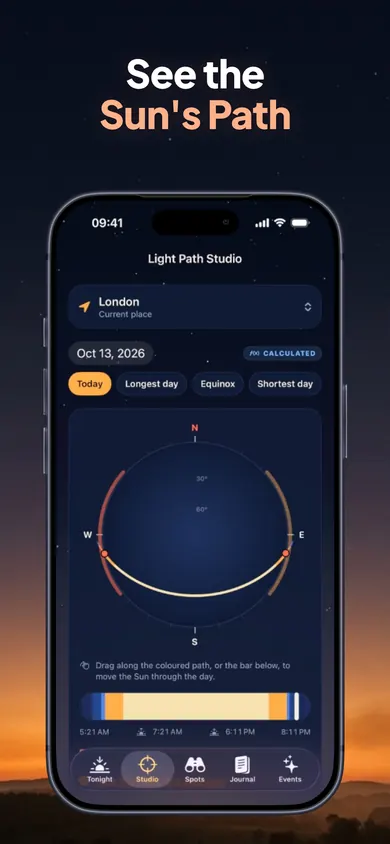
Asterfold Light Path Studio: the Sun’s path for London on a chosen date drawn on a sky dome, coloured by golden hour, blue hour and twilight
Light Path Studio: the Sun’s real path, calculated offline.
Asterfold Forecast vs reality: how did the sunset turn out, rated in two taps against the forecast saved beforehand
After sunset: two taps, compared with the earlier forecast.

Start on your iPhone

Save the window, turn toward the gap, read the dates. Asterfold is free for two viewpoints, works offline for Sun positions, and keeps viewpoints, journal and photos on your phone.

Download Asterfold: Sunset Planner on the App StoreFree on iPhone · iOS 18 or later

Sources and the formula

  1. Sunset bearing used in the quiz: cos(azimuth) = sin(declination) ÷ cos(latitude), flat horizon, refraction ignored, with declination ≈ 23.44° × sin(360° × (day of year − 81) ÷ 365). The standard spherical-astronomy relation; see NOAA’s General Solar Position Calculations for the full equations. Checked against London on 21 December (about 230°) and 21 June (about 310°).
  2. Asterfold: Sunset Planner, App Store listing, version 1.0.0, read November 2026. Flat-horizon statement, viewpoint and frame features, MET Norway forecast and privacy details are quoted from it.